
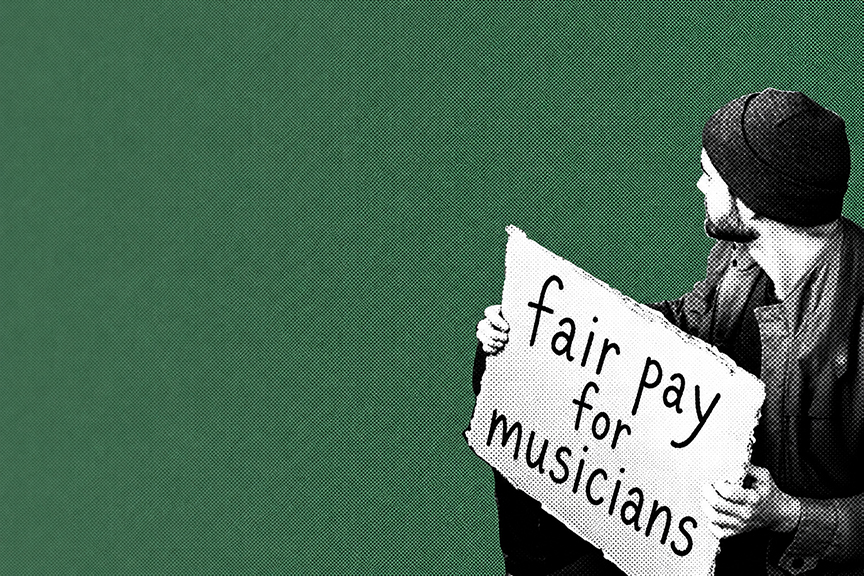
Free labor culture does not damage music all at once. It works slowly. It enters the scene through phrases that sound harmless at first: exposure, opportunity, experience, community, visibility, support the cause, build your name, get in front of people. Sometimes those words are sincere. Sometimes the opportunity truly does help an artist grow. But when unpaid or underpaid work becomes normal instead of exceptional, the entire music ecosystem begins to change around that assumption.
The danger is not one unpaid show. The danger is a culture that quietly teaches artists that compensation is something to hope for later, after they have already proven their value through years of unreimbursed effort.
That belief has shaped too much of independent music. Artists are often expected to rehearse, promote, travel, load gear, perform, sell merchandise, create content, build an audience, and absorb financial risk before anyone is willing to treat the work as economically real. The artist is told to be grateful for the platform, even when the platform depends on the artist’s labor to exist in the first place.
This is where free labor culture becomes more than unfair. It becomes structurally damaging.
When musicians work without meaningful compensation, the cost does not disappear. It moves onto the artist. Someone still pays for the fuel. Someone still buys the strings, cables, drumheads, microphones, software, cases, and repairs. Someone still loses time from other work. Someone still funds the rehearsal, the recording, the transportation, the promotion, and the physical effort of showing up prepared. If the event benefits from music but the musician absorbs the expense alone, the arrangement is not cost-free. It is simply subsidized by the artist.
That subsidy becomes harder to justify when the financial reality of musicians is already unstable. The Music Industry Research Association’s survey of U.S. musicians, conducted with Princeton University Survey Research Center and MusiCares, found that surveyed professional musicians had a median total income of about $35,000, with $21,300 coming from music-related work; 61% said their music income was not enough to meet living expenses. (Survey Research Center)
Those numbers matter because free labor culture often hides behind the idea that musicians are choosing passion over money. But passion does not remove rent, food, transportation, health care, taxes, debt, family responsibilities, or the cost of maintaining professional tools. An artist can love music deeply and still be financially harmed by a culture that repeatedly asks them to work at a loss.
The long-term effect is that music becomes easier for people with financial safety nets and harder for everyone else.
This is one of the least discussed consequences of unpaid creative labor. When compensation is treated as optional, access narrows. Artists with outside support, flexible jobs, family money, low expenses, or unusual freedom may be able to keep participating. Artists without those advantages begin disappearing. They play fewer shows, stop touring, sell equipment, leave bands, delay releases, or reduce their ambitions because the structure around the work never became sustainable.
Over time, free labor culture does not only underpay musicians. It filters who gets to remain a musician.
That has cultural consequences. Scenes lose working-class voices. Regional communities lose artists who could not afford to continue. Venues lose performers with depth and experience. Audiences lose songs that never get written, bands that never reach maturity, and careers that end before the work has time to become fully realized. The public may never notice the loss because the artists disappear quietly. There is no headline when someone finally decides the math no longer works.
The damage also changes how artists see themselves. When musicians spend years being told that payment is secondary to opportunity, many begin internalizing the idea that asking for fair compensation is somehow ungrateful or arrogant. They learn to negotiate against themselves before anyone else has to. They accept unclear terms because they do not want to seem difficult. They absorb losses silently because everyone around them seems to be doing the same. They begin treating financial pain as proof of commitment.
That mindset is dangerous.
Sacrifice has always been part of music, but sacrifice should not become an industry business model. There is a difference between an artist choosing to invest in a meaningful opportunity and a system depending on artists being too hopeful, too insecure, or too afraid of missing out to ask what the work is worth.
Free labor culture also weakens professional standards. When compensation is absent or vague, expectations often become vague too. Artists may feel less empowered to ask for clear communication, proper sound, safe conditions, reasonable scheduling, or respectful settlement. Venues and organizers may become accustomed to low accountability because there is always another artist willing to accept the same arrangement for the chance to be seen. The work becomes emotionally important but professionally undervalued, which creates resentment on every side.
This is not healthy for venues either.
A live music ecosystem built on underpaid labor is unstable by design. Artists burn out. Quality declines. Trust erodes. Scenes become less dependable. Audiences sense when rooms feel careless, mismatched, or poorly supported. Independent venues are already facing serious pressure; the National Independent Venue Association’s 2025 State of Live study found that 64% of independent stages operated without profitability in 2024, even while the sector generated major economic activity. (National Independent Venue Association) That means the answer cannot be pretending every venue has unlimited resources. But it also cannot be asking artists to quietly absorb the shortfall until they collapse.
The healthier conversation begins with honesty.
If a venue has limited money, it should communicate terms clearly. If an event is genuinely community-based, that purpose should be transparent. If an artist chooses to play for a cause, a relationship, a strategic audience, or a personal reason, that choice can be valid. The problem is not every unpaid performance. The problem is the expectation that musicians should routinely provide skilled labor without compensation while other parts of the event economy continue to function as paid work.
The sound engineer expects to be paid. The security staff expects to be paid. The bartender expects to be paid. The landlord expects rent. The utility company expects payment. The ticketing platform takes fees. The equipment costs money. Somehow the artist is often the person asked to accept uncertainty as payment, even though the artist is the reason the event has a performance to sell.
That imbalance is what free labor culture normalizes.
Touring makes the problem even sharper. A 2025 Ditto Music survey of 1,500 independent artists found that 82.1% of global unsigned musicians said they could not afford the costs associated with touring, while 58.3% had turned down touring opportunities for financial reasons. (Ditto Music) When artists already cannot afford the road, unpaid or poorly paid performance opportunities do not merely slow growth. They can make growth impossible.
For working artists, this is why clarity matters. You do not have to treat every low-paying opportunity as exploitation. You do need to understand what the opportunity actually gives back. A show can be worth doing for reasons beyond money, but those reasons should be real enough to name. If the value cannot be explained, measured, or connected to a meaningful purpose, then “exposure” may simply be a softer word for free labor.
The emotional side of this matters too. MusiCares’ 2025 Wellness in Music Survey gathered nearly 3,200 responses from the music community and focused on mental health, health care access, and financial wellness. (MusiCares) That focus reflects a reality many artists already know: financial instability does not stay separate from creativity. It affects sleep, relationships, confidence, decision-making, health, and the ability to keep showing up with genuine energy.
A culture that depends on free labor eventually asks artists to pay twice. First with their money, and then with their well-being.
The long-term effects become visible in the shape of the scene. Fewer artists can afford to tour. Fewer bands survive long enough to become great. Fewer musicians develop slowly through repeated live experience. Fewer working-class artists remain present. More artists become dependent on outside jobs that limit availability. More creative decisions are shaped by survival rather than possibility.
That is not just an artist problem. It is a cultural problem.
If music matters to communities, then the people making it cannot be treated as endlessly replaceable. If live events depend on artists to create value, then artist labor has to be part of the economic structure, not an afterthought. If venues, audiences, promoters, and local scenes want strong music cultures, they cannot rely forever on musicians absorbing the hidden costs alone.
For artists, the first step is internal clarity. Your work has value before someone else validates it with a large audience. Your time has value even when you are still developing. Your expenses are real even when the opportunity sounds exciting. Your willingness to sacrifice should be a conscious decision, not a requirement imposed by a culture that has learned to benefit from your hope.
Free labor culture survives when everyone treats it as normal.
It begins to change when artists ask better questions, when venues communicate honestly, when audiences understand that support requires participation, and when the industry stops confusing passion with unlimited availability. Music can still be generous. Artists can still choose meaningful unpaid work when the purpose is clear. Community can still exist. But generosity only remains healthy when it is chosen freely, not extracted repeatedly from people who are already carrying the cost of keeping the music alive.